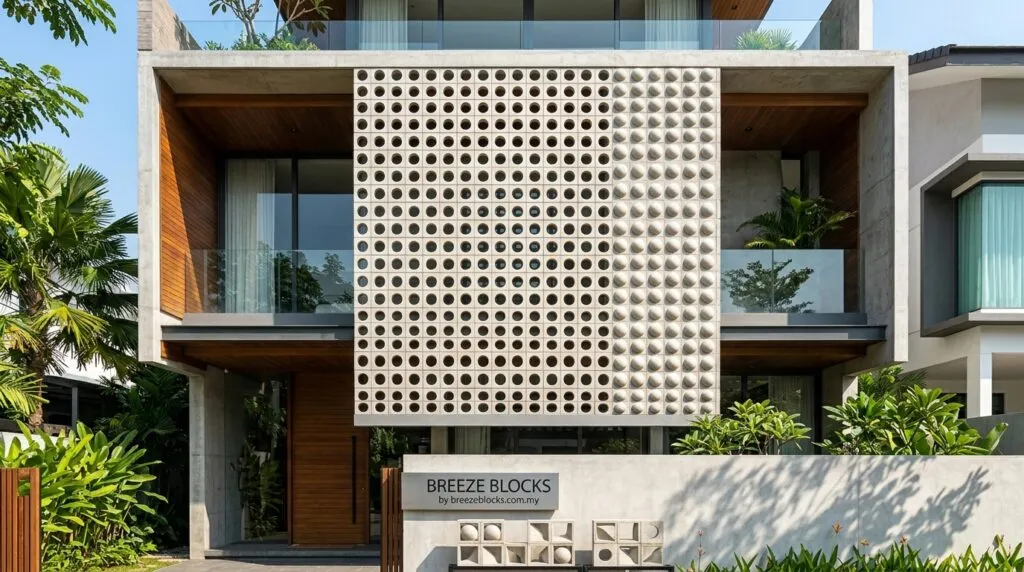
If you have seen patterned cement walls, decorative screens or open-style partitions in modern homes and commercial spaces, you may have come across breeze blocks.
Also known as decorative cement blocks or ventilation blocks, breeze blocks are patterned blocks designed with openings that create a distinctive visual effect while allowing a wall or screen to remain partially open.
For homeowners, interior designers, architects and contractors in Malaysia, breeze blocks can be used for a variety of applications — from boundary walls and garden features to partitions, feature walls and decorative screens.
But what exactly are breeze blocks, how do you choose the right design, and what should you consider before buying them?
This guide explains the basics.
Breeze blocks are decorative cement blocks with patterned openings. Instead of forming a completely solid surface like a conventional wall, the repeated openings create a more visually open structure.
The pattern itself becomes part of the design.
Depending on the selected pattern, breeze blocks can create different levels of openness, visual screening and architectural character. This makes them useful when you want to separate spaces without relying entirely on a conventional solid wall.
For example, a geometric design can create a clean, contemporary appearance, while a leaf or flower pattern can introduce a more decorative or nature-inspired character.
At VIETTILES, breeze cement blocks are available in a wide range of patterns and in both white and grey options, giving homeowners and project designers more flexibility when matching their desired aesthetic.
Breeze blocks are commonly made using cement-based materials and aggregates such as sand.
VIETTILES’ breeze cement blocks are handmade using cement and sand-based materials. The company supplies breeze blocks imported from Vietnam, with a collection covering different decorative patterns and colours.
Because the pattern is incorporated directly into the block, the final appearance of a breeze block wall depends not only on the individual design but also on how the blocks are arranged across the wall.
This is why selecting the right pattern before installation is important.
The standard specification currently published by VIETTILES lists its breeze cement blocks at approximately:
Specifications can vary by product, so it is advisable to confirm the latest product details before placing an order.
The number of blocks required will also depend on your wall dimensions, layout and installation method.
If you are planning a project, calculating the approximate wall area first can help you estimate the number of blocks required.
One reason breeze blocks are attractive for Malaysian properties is their combination of pattern, openness and architectural character.
A conventional solid wall can create a completely enclosed surface. A breeze block wall, depending on its pattern, can create a more open visual effect while still defining a boundary or separating spaces.
Common reasons for considering breeze blocks include:
The actual result depends on the selected pattern, wall design, location and installation.
Breeze blocks are versatile enough for both residential and commercial applications.
1. Boundary Walls
Breeze blocks can be incorporated into boundary wall designs to create a more decorative alternative to a completely plain wall.
The selected pattern can become a prominent visual feature of the property’s exterior.
2. Garden & Outdoor Areas
Use breeze blocks for garden partitions, outdoor screens, courtyard features and decorative landscape structures.
Nature-inspired patterns such as Leaf, Flower, Bamboo and Mountain3 can complement outdoor environments, while geometric designs can create a more contemporary appearance.
3. Interior Partitions
Breeze blocks can also be used to visually separate areas without creating a completely solid partition.
For example, they can be considered for decorative dividers between living areas, dining spaces or other selected interior zones.
4. Feature Walls
Instead of treating a wall as simply a background surface, a patterned breeze block installation can become a design feature.
Patterns such as Cube, Matrix, Diamond, Roman, Rubik and Maze offer different visual styles.
5. Commercial Spaces
Cafés, restaurants, offices and other commercial spaces can use decorative breeze blocks to create distinctive partitions, feature areas and visual backgrounds.
The right pattern can help reinforce the overall design direction of a space.
One of the biggest advantages of breeze blocks is the variety of patterns available.
At VIETTILES, the current collection includes designs such as:
The collection is available in both white and grey, although not every design is available in both colours.
This variety means you can select a pattern based on the visual style and intended application of your project rather than using the same design for every space.
VIETTILES currently offers both white and grey breeze cement blocks.
According to the company’s published information, the difference is primarily in the sand and cement used for the respective colour options, with both stated to have the same quality.
Your choice can therefore be based largely on the visual direction of your project.
White Breeze Blocks
White can create a brighter, cleaner appearance and can work well with contemporary or minimalist design schemes.
Grey Breeze Blocks
Grey provides a more natural cement appearance and can complement industrial, modern or neutral architectural styles.
Rather than choosing purely based on colour, consider how the blocks will work with your surrounding walls, flooring, landscaping, furniture and overall building design.
Choosing breeze blocks should start with the purpose of the installation, rather than simply selecting the pattern that looks attractive in a product photo.
Consider these five factors:
1. What is the purpose?
Are you creating a boundary wall, garden screen, partition, feature wall or decorative element?
2. How open should the pattern be?
Different patterns have different visual openings. A more open pattern can create a stronger sense of openness, while a more enclosed pattern can provide greater visual screening.
3. What design style do you want?
Consider whether your project suits:
4. White or grey?
Look at the surrounding materials and determine which colour fits the overall design.
5. How will the wall be installed?
Wall dimensions, layout, support and reinforcement requirements should be considered before installation. VIETTILES’ published installation guidance includes considerations such as mortar joints, reinforcement and curing.
For structural requirements, always discuss the installation with your contractor or an appropriately qualified professional.
Breeze blocks can be used for both indoor and outdoor applications, according to VIETTILES’ published product information.
However, the suitability of a particular installation depends on factors such as the wall design, location, support, exposure and installation method.
For an outdoor project, consider the surrounding environment and discuss the appropriate installation method with your contractor before construction.
Now that you understand the basics of breeze blocks, the next step is to find a pattern that suits your project.
VIETTILES offers a collection of handmade cement breeze blocks from Vietnam, with a variety of decorative patterns available in white and grey options.
From nature-inspired Leaf and Flower designs to geometric Cube, Matrix and Diamond patterns, you can explore different styles for residential, commercial and outdoor applications.
Ready to explore the right design for your project?
Browse the complete collection of breeze cement blocks and compare the available patterns and colours.
No. Breeze blocks are designed with decorative openings and patterns, giving them a different visual and functional purpose from conventional solid cement blocks.
Yes. They can be used for selected interior applications such as decorative partitions and feature walls.
Yes. VIETTILES states that its breeze blocks are suitable for both indoor and outdoor applications. Installation requirements should be considered according to the specific project.
VIETTILES states that its white and grey blocks have the same quality, with the main difference being the sand and cement used to achieve the respective colour.
Start by identifying your application, desired level of visual openness, preferred design style and colour. You can then compare suitable patterns from the product collection.
Choosing a breeze block is not simply about selecting the most attractive pattern.
The right choice should consider where the block will be used, the desired visual effect, the level of openness, the overall architectural style and the practical requirements of installation.
Explore the VIETTILES collection to compare different breeze block patterns and colours for your next project.