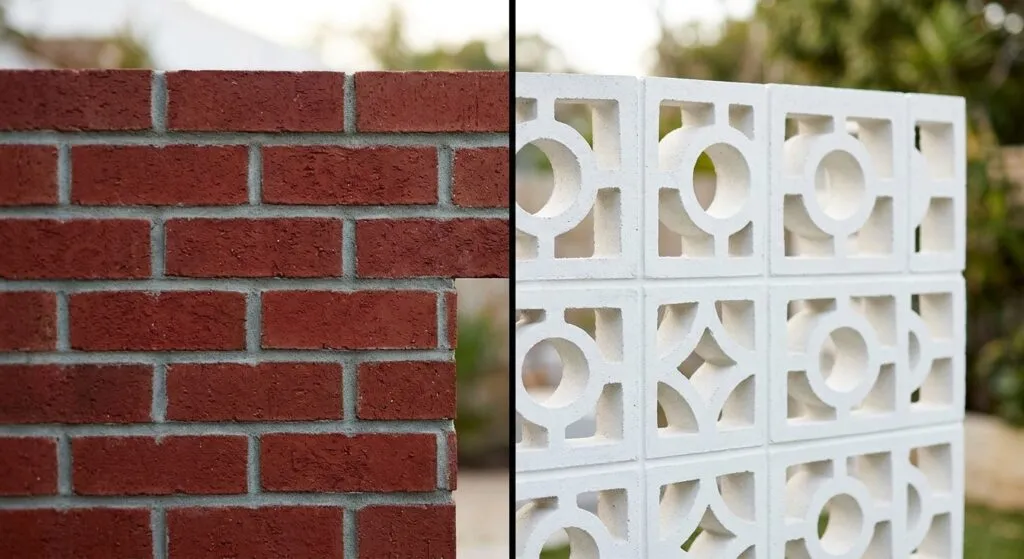
When planning a new wall, partition or boundary feature, bricks and breeze blocks can serve very different purposes.
A traditional brick wall is commonly associated with a solid, enclosed structure. Breeze blocks, on the other hand, are patterned cement blocks with openings that create a more visually open design.
So, which one should you choose?
The answer depends on what you want the wall to achieve.
If your priority is a conventional solid wall, bricks may be more appropriate. If you want to introduce pattern, visual openness, decorative character and partial separation, breeze blocks can offer a different design approach.
In this guide, we compare breeze blocks vs brick walls and explain the factors to consider before choosing one for your Malaysian home or project.
Breeze blocks are decorative cement blocks featuring patterned openings.
Unlike a conventional solid wall, the openings form part of the design and create a distinctive visual effect. Depending on the pattern selected, breeze blocks can be used to create decorative walls, partitions, screens and other architectural features.
At VIETTILES, the breeze cement block collection includes a wide range of patterns, including Leaf, Flower, Bamboo, Cube, Matrix, Diamond, Roman, Maze and Window designs, with selected products available in white and grey.
This makes breeze blocks particularly suitable when the appearance of the wall is an important part of the overall design.
A brick wall is typically constructed using individual bricks or masonry units bonded together with mortar.
Because bricks are generally arranged to form a substantially solid surface, brick walls are commonly used when the objective is to create a more enclosed boundary, partition or building wall.
Brick walls can also be finished, painted or incorporated into different architectural styles.
The important distinction is that a conventional brick wall and a breeze block wall are not necessarily competing products for exactly the same purpose.
Instead, they can solve different design and space-planning requirements.
The easiest way to understand the difference is to compare them based on how you intend to use the wall.
| Consideration | Breeze Blocks | Brick Walls |
| Appearance | Patterned and decorative | Solid masonry appearance |
| Openness | Openings are incorporated into the design | Generally solid |
| Visual separation | Partial separation | Greater enclosure |
| Ventilation | Open patterns allow air to pass through | Solid wall limits direct air passage |
| Natural light | Openings can allow light through | Generally blocks direct light |
| Design variety | Many decorative patterns | Appearance depends on brick type, finish and layout |
| Typical applications | Screens, partitions, feature walls, garden features | Boundaries, walls and enclosed spaces |
| Design focus | Pattern and architectural detail | Solid structure and enclosure |
This comparison does not mean one is universally better than the other.
The right option depends on your project purpose, desired appearance, privacy requirements and installation conditions.
If visual design is one of your main considerations, breeze blocks offer a distinctive advantage: the pattern is part of the building element itself.
For example:
Patterns such as:
can complement garden areas, courtyards and spaces where you want a more organic visual character.
Patterns such as:
can suit contemporary and minimalist design directions.
Designs such as:
can create a stronger decorative statement.
A brick wall can also be visually attractive, particularly when the brick finish, colour, laying pattern and surrounding materials are carefully selected. However, the visual language is generally different from the patterned appearance created by breeze blocks.
One of the most noticeable differences between breeze blocks and conventional brick walls is openness.
Breeze blocks have openings within the individual units. When these are assembled into a wall or screen, the openings remain part of the overall design.
This can make them useful for applications where you want to maintain a degree of openness between two areas.
For example:
The actual amount of airflow depends on the selected pattern, wall configuration and surrounding environment.
A conventional brick wall is generally much more enclosed because the bricks form a substantially solid surface.
Therefore, if airflow and visual openness are important considerations, it is worth comparing the actual patterns rather than treating all wall materials as equivalent.
Privacy is another important consideration.
A completely solid brick wall generally provides a higher level of visual separation because there are few or no openings through the wall.
Breeze blocks work differently.
Their patterned openings allow you to create partial visual screening while maintaining an open wall concept.
However, different breeze block designs provide different levels of openness.
For example, a more open pattern may create a stronger sense of visual connection between spaces, while a tighter pattern may provide greater visual screening.
Therefore, if privacy is important, don’t simply choose a breeze block based on its appearance.
Consider:
Purpose → Pattern openness → Viewing angle → Wall location → Desired privacy
This is particularly important for boundary walls, garden screens and partitions.
A solid brick wall can significantly separate one space from another.
Breeze blocks can create a different visual effect because light can pass through the openings in the pattern.
This can be useful for selected applications where you want to divide a space without creating a completely enclosed appearance.
For example, breeze blocks can be considered for:
The resulting amount of light will depend on the selected pattern, wall orientation and surrounding conditions.
Breeze blocks are particularly suitable when the wall itself is part of the design.
Common applications include:
If you are looking specifically for decorative patterns, you can browse the available VIETTILES breeze block collection and compare different designs according to your project requirements.
Breeze blocks should not automatically replace brick walls.
A conventional brick wall may be more appropriate when your primary requirement is a solid and enclosed wall.
For example, you may want to consider a traditional masonry solution when:
The structural requirements of a wall depend on its dimensions, location, loads and intended use.
For structural applications, consult your contractor or an appropriately qualified professional rather than selecting a wall material based solely on appearance.
Instead of asking:
“Are breeze blocks better than bricks?”
a better question is:
“Which solution is more suitable for my project?”
Use this simple guide:
Choose breeze blocks when you want:
✔ Decorative patterns
✔ A more visually open wall
✔ Partial separation between spaces
✔ Design-focused feature walls
✔ Garden or courtyard screens
✔ Different architectural patterns
✔ White or grey decorative cement block options
Consider a conventional brick wall when you want:
✔ A substantially solid wall
✔ Greater visual enclosure
✔ A traditional masonry appearance
✔ Fewer openings through the wall
✔ A conventional wall construction approach
And remember: you don’t necessarily have to choose only one.
A project can potentially combine solid wall sections with breeze block sections to create contrast, depending on the design and technical requirements.
If you decide that breeze blocks suit your project, the next question becomes:
Which pattern should you choose?
Start with the purpose of the wall.
For a nature-inspired appearance
Consider patterns such as Leaf, Flower, Bamboo or Floral.
For modern geometric architecture
Consider Cube, Matrix, Diamond, Square or Octagon.
For a more artistic feature
Explore Maze, Rubik, Smile, Lamp or Space.
Then consider the level of openness and privacy required.
A design that looks excellent in a product photograph may not necessarily be the best choice for your particular wall location.
If you are considering breeze blocks instead of a conventional solid wall, the next step is to compare actual patterns and colours.
VIETTILES offers a collection of handmade cement breeze blocks imported from Vietnam, with a variety of decorative designs for residential, commercial and outdoor applications.
Explore the available collection to find a pattern that fits your project’s intended appearance and application.
Neither is universally better. Breeze blocks and brick walls serve different purposes. Breeze blocks are particularly useful for decorative, partially open applications, while conventional brick walls provide a more solid and enclosed wall solution.
Because breeze blocks contain patterned openings, they allow air to pass through the openings. The actual airflow depends on the design, wall configuration and surrounding environment.
Yes. Breeze blocks can be incorporated into boundary wall designs, garden screens and other outdoor applications. The appropriate installation method should be determined according to the specific project.
Yes, depending on the pattern and wall configuration. More enclosed patterns can provide greater visual screening, while more open designs provide greater visual openness.
Potentially, yes. A design can incorporate both solid wall sections and breeze block sections. The feasibility depends on the project’s design and construction requirements.
Choosing between a breeze block and a brick wall ultimately comes down to what you want your wall to achieve.
If you want decorative patterns, visual openness and a distinctive architectural feature, breeze blocks can be an option worth considering.
Explore the VIETTILES collection to compare different breeze block designs, colours and patterns for your project.